Lower-Carbon Manufacturing Begins With Better Material Decisions
Every polyurethane product begins with raw materials. By introducing regenerated polyols made from recycled plastic waste, PU manufacturers can create a more circular raw-material pathway and explore opportunities to reduce the upstream carbon footprint of their products.
Focus
Material + Carbon
Why Low Carbon Manufacturing Matters
Carbon impact is not created only inside the factory. A significant part of a product's environmental footprint can be associated with the materials entering the manufacturing process.
Raw Materials
The production of virgin chemical feedstocks can carry significant upstream energy and carbon impacts before materials reach the PU factory.
Energy
Electricity, heating, reaction conditions and other process utilities influence the carbon intensity of chemical production.
Material Efficiency
Higher yields, better feedstock utilization and lower process losses can help reduce the resources required for each kilogram of finished material.
Circular Feedstocks
Recovering useful chemistry from plastic waste creates an alternative pathway to part of the virgin raw-material demand.
The Carbon Question Starts Before the Factory Gate
A PU manufacturer may operate an efficient production plant, yet the materials used in its formulations already carry an upstream environmental footprint.
Enviol addresses this upstream opportunity by converting suitable recycled plastic waste into regenerated polyester polyols that can be evaluated as part of a PU manufacturer's formulation.
From raw material to PU product
Conventional pathway
Virgin Chemical Feedstocks
Material conversion
Virgin Polyol
Circular alternative
PET-Derived Regenerated Polyol
Application
Polyurethane Manufacturing
Low-carbon manufacturing does not begin with the finished product.It begins with the materials selected to make it.
Where Does the Carbon Footprint Enter PU Manufacturing?
The environmental impact of a polyurethane product is influenced not only by what happens inside the PU factory, but also by the materials and energy required to produce the raw materials that enter the factory.
Raw Materials
Production of petrochemical feedstocks and other chemical intermediates contributes to the upstream footprint of conventional polyols.
Chemical Conversion
Converting basic chemical feedstocks into polyol intermediates requires energy, processing equipment and supporting utilities.
Transportation
Feedstock sourcing, intermediate transport and delivery of finished raw materials all contribute to the overall supply-chain footprint.
PU Processing
Mixing, metering, curing, foaming and other manufacturing operations add their own energy requirements to the product footprint.
Pathway 01
Conventional Virgin Material Route
Fossil Resources
Oil & gas based resources
Chemical Feedstocks
Intermediates & building blocks
Virgin Polyol
Produced from virgin chemistry
Manufacturing
PU Factory
Final Material
Polyurethane Product
Pathway 02
Circular Material Route
Plastic Waste
Suitable PET waste streams
Chemical Recovery
Recover useful chemical value
Regenerated Polyol
Recovered chemistry prepared for PU applications
PU Manufacturing
Evaluate regenerated polyol within the required formulation.
New PU Product
Keep recovered material value within the industrial material cycle.
Two Material Pathways. Two Different Starting Points.
The PU manufacturing process may look similar at the factory, but the upstream material pathway can be very different.
Conventional
Virgin Polyol
Virgin petrochemical feedstocks
Chemical conversion
Virgin polyol production
PU manufacturing
The raw material pathway begins with newly extracted and processed chemical resources.
Circular Alternative
PET-Derived Polyol
Recycled plastic waste
Feedstock preparation
Chemical recovery
Regenerated polyol
PU manufacturing
Existing polymer material becomes a potential feedstock for producing new industrial chemistry.
The Material Decision
The opportunity is not only inside the PU factory.
It begins with the choice of raw material entering the factory. Replacing a portion of virgin polyol with a suitable regenerated polyol can introduce recovered material into the PU supply chain and create an opportunity to reduce the upstream footprint of the formulation.
Virgin
Material route
Recovered
Material route
Same PU objective→different raw-material pathway
What Happens When Virgin Polyol Is Replaced?
The potential carbon benefit can be illustrated by comparing the upstream footprint of a conventional virgin polyol with a regenerated polyol produced from recycled PET waste.
Conventional route
1 kg Virgin Polyol
Virgin chemical feedstocks
Chemical processing
Virgin polyol
Illustrative cradle-to-gate benchmark
3.5
kg CO₂e / kg polyol
Circular route
1 kg PET-Derived Polyol
Recycled PET waste
Chemical recovery / glycolysis
Regenerated polyester polyol
Illustrative recycling scenario
1.3
kg CO₂e / kg polyol
Illustrative calculation
The Difference Per Kilogram
Virgin polyol
3.5
kg CO₂e/kg
PET-derived polyol
1.3
kg CO₂e/kg
Difference
2.2
kg CO₂e/kg
Starting point
1 kg
Virgin Polyol
Conventional material pathway
Material substitution
Replace with regenerated polyol
Derived from suitable recycled PET waste
Illustrative difference
2.2
kg CO₂e / kg
potential upstream difference*
Calculation basis
Illustrative Input Values
| Parameter | Illustrative value |
|---|---|
| Virgin polyol footprint | 3.5 kg CO₂e/kg |
| PET-derived polyol footprint | 1.3 kg CO₂e/kg |
| Material substituted | 1.0 kg |
| Illustrative difference | 2.2 kg CO₂e |
Important
An Illustrative Scenario, Not a Certified Carbon Claim
The figures shown here demonstrate the potential scale of the opportunity. Actual carbon savings depend on the specific recycled feedstock, recycling process, energy sources, transportation, product formulation, yield and the virgin material displaced.
A product-specific life-cycle assessment would be required to establish a verified carbon footprint for a particular Enviol regenerated polyol.
The opportunity
Every kilogram of virgin polyol replaced creates an opportunity to reduce upstream carbon intensity.
The next question is scale: what could this mean for a PU factory consuming tens or hundreds of tonnes of polyol every month?
What Could This Mean at Factory Scale?
A small percentage change in raw-material sourcing can become significant when applied to the annual polyol consumption of a large polyurethane manufacturing operation.
Illustrative factory example
50 MT of Polyol Consumption per Month
Monthly consumption
50
MT polyol / month
Annual consumption
600
MT polyol / year
Material opportunity
20–30%
illustrative substitution range
Calculation method
Substituted polyol
kg / year
2.2
kg CO₂e / kg
Potential difference
kg CO₂e / year
Three illustrative scenarios
The More Material You Replace, the Larger the Opportunity
The following examples apply the same illustrative 2.2 kg CO₂e/kg difference from Part 3 to different substitution levels.
Scenario 01
20%
Scenario 02
25%
Scenario 03
30%
Factory-scale illustration
Annual Material Substitution Scenarios
| Substitution | Annual polyol use | Regenerated polyol | Virgin polyol displaced | Illustrative CO₂e difference |
|---|---|---|---|---|
| 20% | 600 MT | 120 MT | 120 MT | 264 MT CO₂e |
| 25% | 600 MT | 150 MT | 150 MT | 330 MT CO₂e |
| 30% | 600 MT | 180 MT | 180 MT | 396 MT CO₂e |
Think beyond kilograms
Small substitution percentages can create large annual material flows.
What this means
The opportunity scales with material consumption.
A manufacturer does not need to replace its entire polyol requirement at once. Depending on formulation, product requirements and technical qualification, a partial substitution strategy can introduce recovered material while maintaining the required manufacturing performance.
120–180
MT regenerated polyol / year
264–396
MT CO₂e potential difference / year
Important qualification
These numbers illustrate potential — they do not represent a verified Enviol carbon footprint.
The calculation assumes that each kilogram of regenerated polyol displaces one kilogram of virgin polyol and applies the illustrative footprint difference introduced in Part 3. Actual results will depend on the specific product, feedstock, recycling route, process energy, yield, transportation, allocation methodology and the virgin material displaced.
From calculation to implementation
The next step is not simply replacing a raw material.
It is building a practical pathway for a PU manufacturer to introduce regenerated polyol into its existing manufacturing system — with technical qualification, formulation control, documentation and reliable supply.
How Enviol Helps PU Manufacturers Build a Lower-Carbon Material Pathway
Enviol connects recycled plastic waste with industrial polyol applications, helping PU manufacturers explore the controlled introduction of regenerated polyols into their existing formulations.
Enviol circular material pathway
From Plastic Waste to PU Raw Material
Feedstock
Recycled PET
Suitable post-consumer or post-industrial PET streams
Recovery
Chemical Recycling
Recover useful chemical value through controlled processing
Chemistry
Regenerated Polyol
Prepared for evaluation in selected PU applications
Application
PU Manufacturing
Introduce the material through controlled technical trials
05 — Material outcome
Recovered Material Remains in the Industrial Value Chain
Instead of treating suitable plastic waste only as a disposal challenge, its chemical value can become part of a new PU raw-material pathway.
Beyond the polyol
Enviol Helps Build the Transition, Not Just Supply the Material
A sustainable raw-material strategy needs more than a new product. It requires technical evaluation, formulation support and a controlled path from laboratory testing to production.
Material Matching
Identify regenerated polyol characteristics that are compatible with the customer's target PU application and formulation.
Technical Evaluation
Support sample evaluation, formulation trials and comparison against the customer's existing material requirements.
Qualification
Move from laboratory assessment toward controlled production trials once technical and quality requirements are established.
Supply Integration
Develop a repeatable supply pathway so regenerated material can become part of the manufacturer's ongoing raw-material strategy.
From first conversation to production
A Controlled Path to Material Substitution
The objective is not to change a PU formulation blindly. The objective is to establish where regenerated polyol can technically and commercially fit within the existing process.
Application & Requirement
Understand the PU system, target properties, current polyol grade and relevant processing conditions.
Sample & Laboratory Trial
Test the regenerated polyol against the required physical, chemical and processing parameters.
Controlled Production Trial
Validate the material at increasing substitution levels while monitoring product quality and process performance.
Ongoing Material Strategy
Establish specifications, documentation and supply planning for the approved regenerated polyol.
For PU manufacturers
The Goal Is More Than Recycled Content.
A well-designed regenerated-polyol program can help a manufacturer explore circular feedstocks while maintaining focus on formulation performance, quality consistency and supply reliability.
Reduce dependence on virgin feedstocks
Introduce recovered chemical value into selected formulations.
Increase circular material content
Build a measurable pathway for incorporating recycled feedstocks.
Explore lower-carbon raw-material options
Evaluate the potential upstream footprint advantage of regenerated chemistry.
Create a scalable material pathway
Move from sample evaluation toward qualified industrial supply.
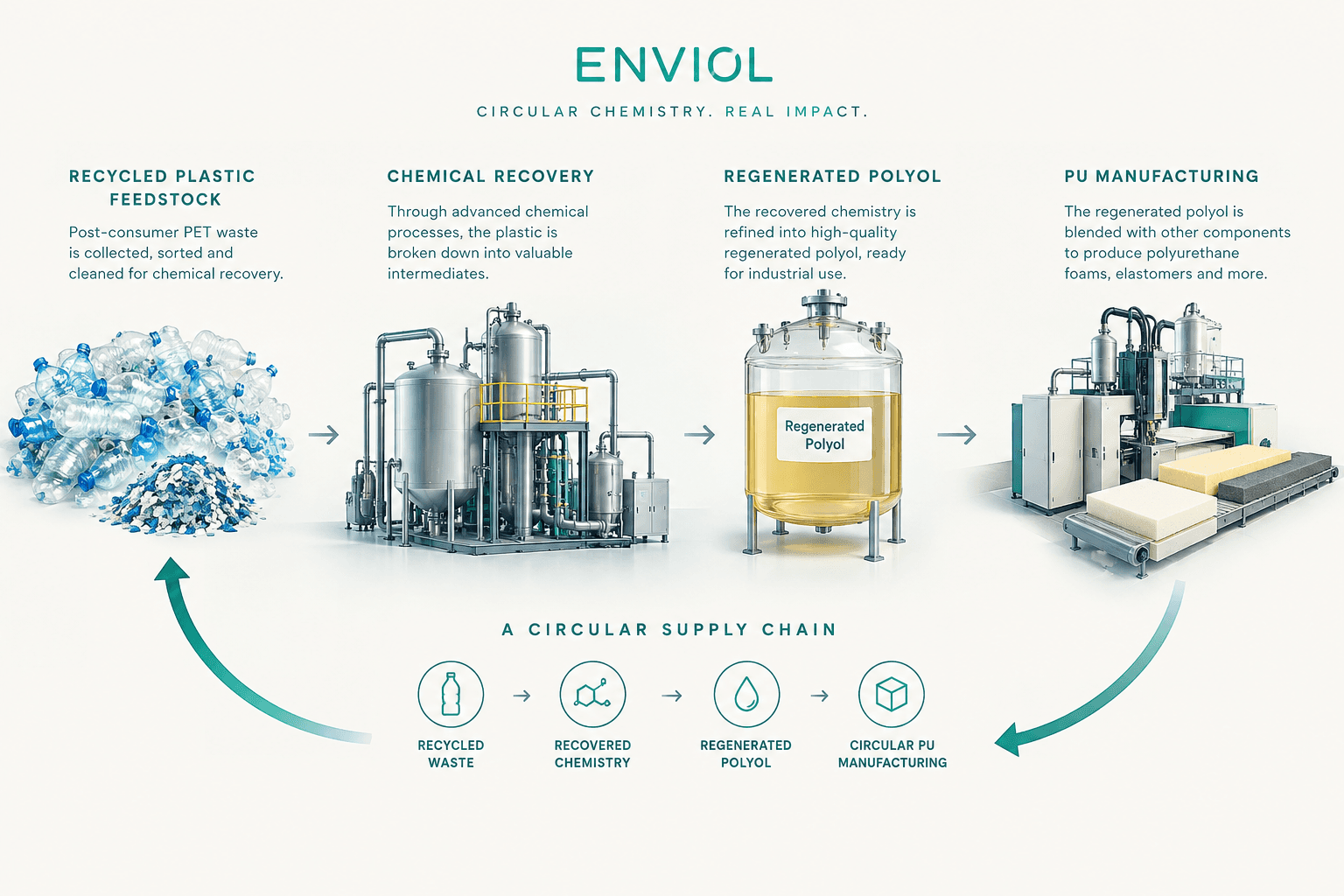
Original Enviol Visual
Visual showing a generic PU manufacturing plant receiving regenerated polyol, with a circular material pathway from PET waste to new PU products.
Circular manufacturing
Recovered chemistry becomes part of the next product cycle.
Enviol's role
Making Circular Polyol Adoption Practical for Industry
Enviol's objective is to connect recycled plastic feedstocks with real industrial applications — developing regenerated polyols that can be technically evaluated, qualified and integrated into appropriate PU manufacturing systems.
Waste
Feedstock
Chemistry
Recovery
Polyol
Regenerated
PU
Application
Building a Lower-Carbon PU Supply Chain
Replacing virgin material is only the beginning. The long-term opportunity is to create a measurable, traceable and repeatable material pathway that can support both manufacturing and sustainability objectives.
Measure what changes
From Sustainability Idea to Measurable Material Strategy
A credible lower-carbon program should connect material substitution with technical data, quantities, sourcing and documented assumptions.
Material Data
Define the regenerated polyol grade, specification, composition and relevant technical properties.
Quantity Tracking
Record how much regenerated polyol is introduced and how much conventional material it replaces.
Carbon Assessment
Assess the relevant life-cycle stages using product-specific data and clearly defined calculation assumptions.
Report & Improve
Use the results to identify further substitution opportunities and continuously improve the material strategy.
Data points
What Should Be Tracked?
| Parameter | Why it matters |
|---|---|
| Polyol consumption | Establishes the material baseline. |
| Regenerated content | Shows the quantity of recovered material introduced. |
| Virgin material displaced | Forms the basis for substitution calculations. |
| Feedstock & process data | Improves the accuracy of carbon assessment. |
| Transportation | Accounts for relevant supply-chain movements. |
| Energy source | Helps determine process-related emissions. |
Better data → better decisions
Carbon reduction becomes more credible when the material flow is measurable.
Instead of relying only on broad sustainability claims, a manufacturer can track the quantity of regenerated polyol used, the virgin material displaced and the assumptions behind the carbon calculation.
kg
Material tracked
CO₂e
Footprint assessed
Measure→Compare→Improve→Scale
Original Enviol Visual
Building a measurable circular PU supply chain
Visual placeholder for an original Enviol industrial illustration showing PET waste, chemical recovery, regenerated polyol, PU manufacturing, material tracking and a circular return pathway.
Circular supply chain
The objective is to keep material value moving through the industrial system — with better data at every stage.
The Enviol approach
Better Materials Can Be the Starting Point for Better Manufacturing.
Enviol is developing regenerated polyols that connect recycled plastic waste with industrial polyurethane applications. The objective is simple: recover chemical value, create useful materials and help manufacturers explore more circular raw material pathways.
Start the conversation
Explore a More Circular Polyol Strategy for Your PU Products.
Tell us about your current polyol system, application and material requirements. Enviol can help identify whether a regenerated polyol pathway is technically worth evaluating.
Recycled waste→Recovered chemistry→Regenerated polyol→Circular PU manufacturing
Enviol Polytech Solutions
Carbon figures presented on this page are illustrative scenarios based on published literature and stated assumptions. They are intended to demonstrate the potential scale of material substitution and should not be interpreted as a product-specific, independently verified carbon footprint or guaranteed emissions reduction. Actual results depend on feedstock, process technology, energy mix, yield, transportation, allocation methodology, formulation and the virgin material displaced.