Polymer Waste Regeneration
From discarded polymers to regenerated chemical resources.
PET is everywhere.
Cold-drink bottles, water bottles, fruit-juice containers, sports and energy drinks, edible-oil packaging, food packaging, personal-care products and many everyday consumer products depend on PET.
But PET does not begin with a bottle. It begins with chemistry — and much of that chemistry ultimately depends on fossil resources such as petroleum and natural gas.
Where does PET come from?
A PET bottle is the final product of a multi-stage petrochemical and polymer manufacturing chain.
Petroleum & Natural Gas
Fossil carbon resources
Chemical Building Blocks
Aromatic and glycol intermediates
PET Resin
Polymerized material
PET Products
Bottles, containers, packaging and everyday products
A bottle may be used for minutes.
Its material story begins much earlier —
and does not end when the bottle is discarded.
What happens after the bottle is used?
The useful life of a PET product may be short. The polymer itself does not simply disappear. After collection, it can follow very different pathways.
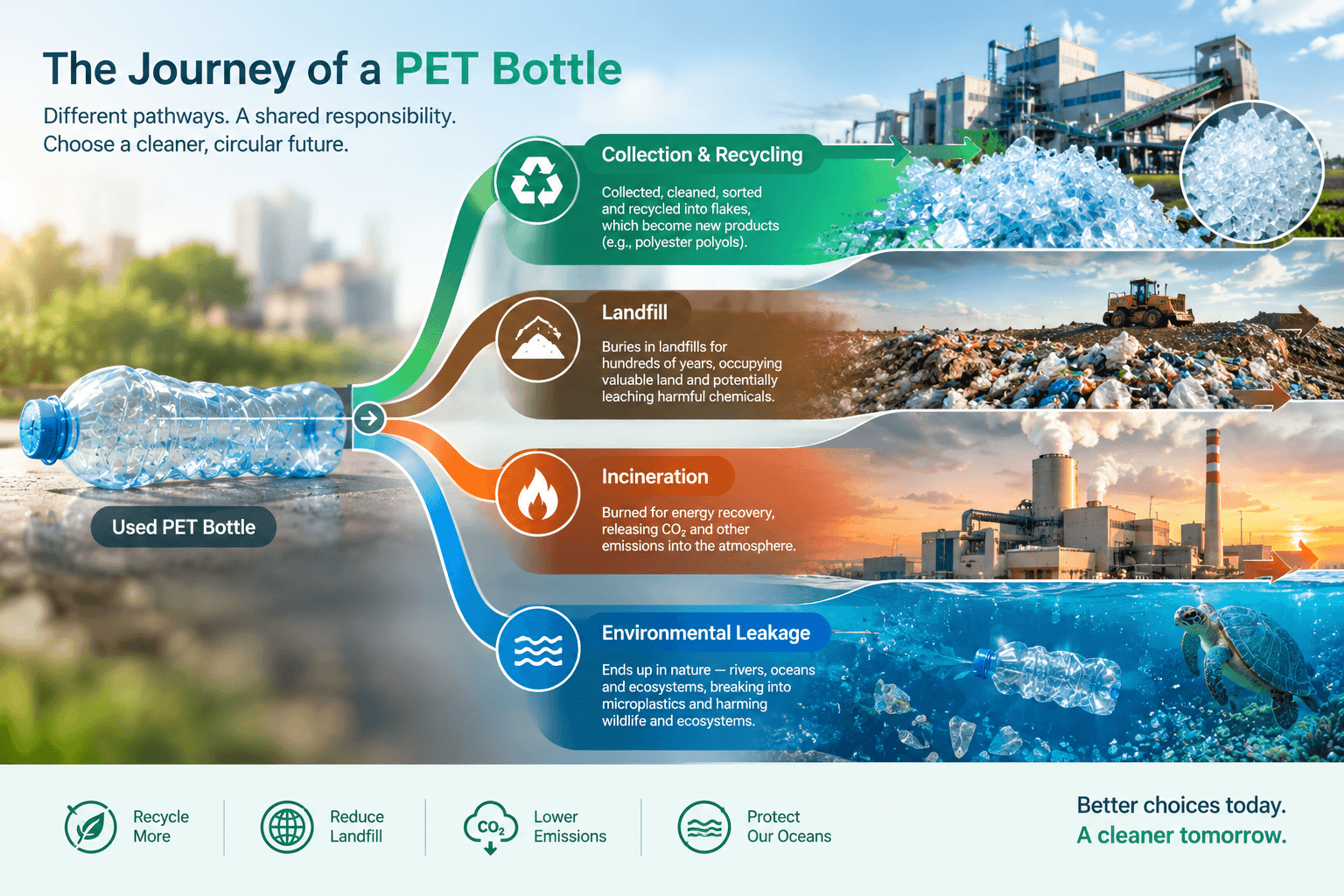
PET Product
Used and discarded
Landfill
Material is removed from productive circulation and retained in a disposal system.
Incineration
Polymer carbon is converted through combustion, with energy recovery possible in some systems.
Recycling
PET can be collected and converted into recycled PET, fibres and other products.
Environmental Leakage
Uncollected or mismanaged plastic can enter terrestrial and aquatic environments.
The question is not only where PET goes after use.
It is how much of its original chemical value
we are able to recover.
The global scale of the challenge
PET is only one part of the global plastics system. The scale of plastic production and waste makes material recovery a global industrial challenge.
Global plastics production in 2019
Plastic waste generated in 2019
Of plastic waste ultimately recycled
Plastics lifecycle greenhouse-gas emissions in 2019
Source: OECD, Global Plastics Outlook. Figures refer to the global plastics system in 2019 and are shown here as a historical baseline.
| Pathway | What happens? | Material perspective |
|---|---|---|
| Landfill | Waste is placed into disposal systems. | Polymer remains outside productive material circulation. |
| Incineration | Polymer is combusted, sometimes with energy recovery. | Chemical material value is largely lost. |
| Mechanical Recycling | PET is processed into recycled polymer products. | Valuable route, but collection, contamination, additives and processing history can affect quality. |
| Chemical Regeneration | Polymer chemistry can be broken down into recoverable chemical intermediates. | Creates an opportunity to return recovered chemistry into new material systems. |
What if PET does not always have to become PET again?
Mechanical recycling is an important part of the circular plastics economy. But recycling does not have to mean only reproducing the original polymer.
PET is a polyester. Its polymer chains contain chemical structures that can be transformed through appropriate chemical processes into useful intermediates for new material systems.
Mechanical Recycling
Preserves the polymer as a material and can support bottle-to-bottle, fibre and other applications.
Fibre / Material Cascading
Extends the useful life of PET chemistry into different material applications.
Chemical Regeneration
Opens a pathway for recovered PET chemistry to participate in new polymer and polyurethane systems.
PET Recovery Pathway Matrix
Different pathways preserve different forms of material value.
| Pathway | Starting Material | Transformation | Potential Output | Value Recovery |
|---|---|---|---|---|
| Landfill | PET waste | Disposal | None as a material | Very low |
| Incineration | PET waste | Combustion | Heat / energy | Energy recovery |
| Mechanical Recycling | PET waste | Physical reprocessing | rPET / fibres / products | Polymer-level |
| Chemical Regeneration | PET waste | Chemical depolymerisation / glycolysis | Chemical intermediates | Chemical-level |
| Polyol Route | PET-derived chemistry | Controlled polyol synthesis | Polyester Polyol | New PU material |
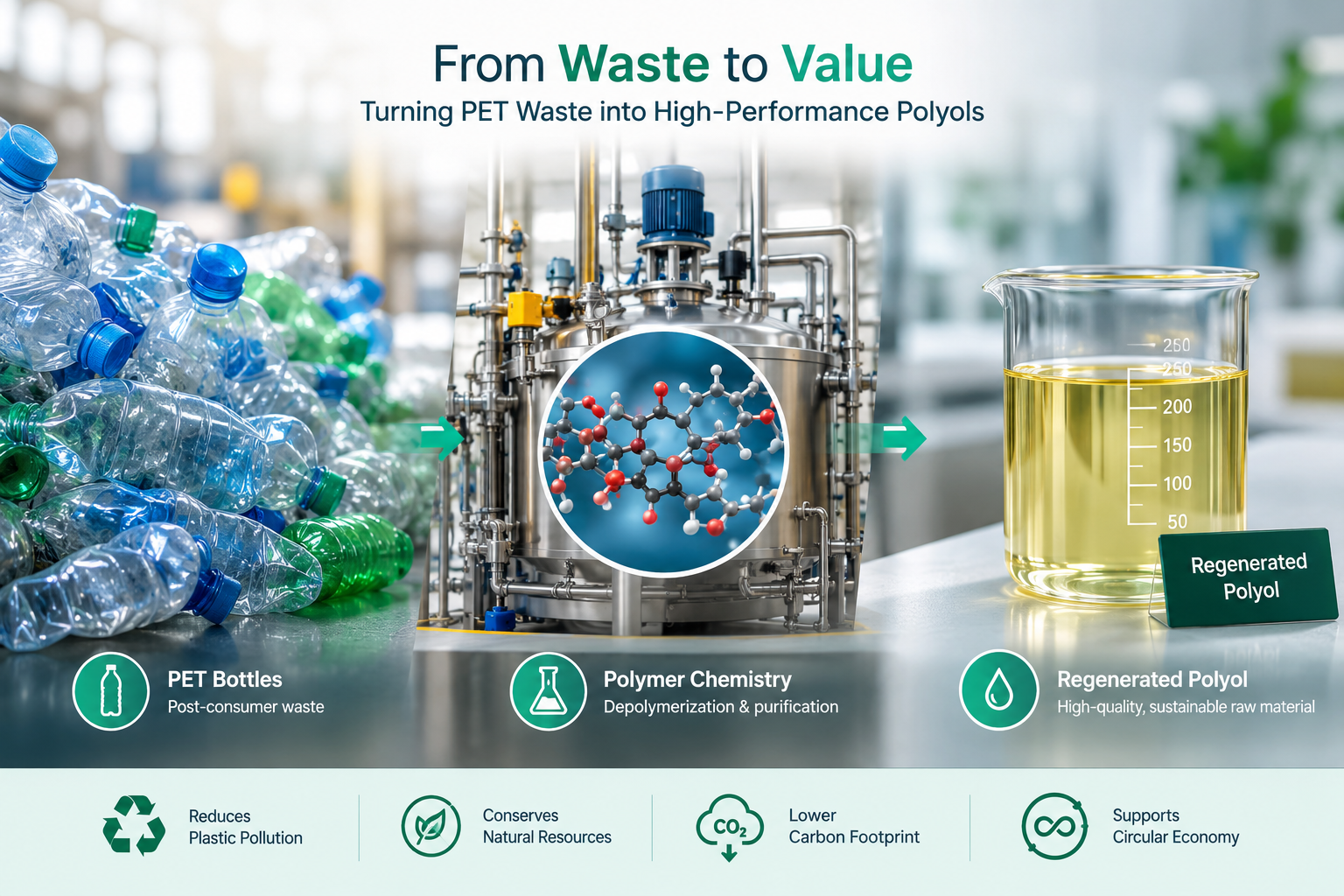
PET Waste → Regenerated Polyester Polyol
Waste PET
Bottles / PET waste
Preparation
Sorting / cleaning / size reduction
Glycolysis
Controlled chemical conversion
Polyester Polyol
Designed for PU formulations
PET glycolysis uses a glycol such as DEG or another suitable glycol to break ester linkages and produce hydroxyl-containing oligomeric/intermediate material. With appropriate formulation and subsequent polycondensation or modification, this chemistry can be directed toward polyester polyols with properties suitable for selected polyurethane applications.
What determines a regenerated polyol's performance?
Recycled feedstock alone does not define the final material. Formulation and process control determine the resulting polyol.
| Parameter | Why it matters | Application relevance |
|---|---|---|
| Hydroxyl Value | Indicates the concentration of hydroxyl groups available for reaction with isocyanates. | Strongly influences formulation stoichiometry, crosslink density and final properties. |
| Functionality | Describes the average number of reactive groups per molecule. | Important for network formation and PU structure. |
| Molecular Weight | Influences chain length and reactive-group density. | Affects flexibility, hardness and formulation behaviour. |
| Viscosity | Reflects flow and processing characteristics. | Important for mixing, pumping and application. |
| Acid Value | Indicates residual carboxylic acidity. | Can affect reaction behaviour and formulation stability. |
| Recycled Content | Quantifies the contribution of recovered feedstock. | Important for circularity claims and material sourcing. |
From Polyester Polyol to Polyurethane
Polyester polyols are reactive building blocks used across multiple polyurethane technologies. Suitability depends on the specific polyol design and formulation requirements.
Rigid PU Foam
Potential use in rigid polyurethane foam systems where aromatic polyester polyol characteristics are required.
PU Coatings
Potential building block for selected protective, industrial and specialty polyurethane coatings.
PU Adhesives
Potential use in adhesive formulations requiring polyester-based reactive components.
PU Sealants
Potential application in selected moisture-curing and two-component polyurethane sealant systems.
PU Elastomers
Potential building block for selected elastomer formulations requiring polyester chemistry.
Artificial Leather
Potential contribution to polyester-based polyurethane systems used in synthetic and artificial leather.
From Polymer Waste to Regenerated Chemistry
Enviol is developing chemical recycling pathways that seek to transform PET waste into useful polyester-based chemical resources for new material applications.
Our focus is not simply to recover waste. It is to recover chemical value and explore where that regenerated chemistry can create new industrial value.
The Enviol Circular Chemistry Loop
A pathway from discarded PET to new polyurethane materials.
PET Waste
Post-consumer / industrial PET
Preparation
Sorting, cleaning & processing
Regeneration
Controlled chemical conversion
Polyester Polyol
Engineered reactive material
Polyurethane
New material applications
Waste polymer → recovered chemistry → new material value
Recover more than material.
Conventional recycling can preserve PET as a polymer. Chemical regeneration creates another possibility: transforming polymer waste into chemical intermediates that can participate in entirely different material systems.
Recycling should expand possibilities.
The objective is not to claim that one recycling pathway should replace every other pathway. Different waste streams require different solutions.
Enviol is exploring where PET-derived polyester polyols can technically and economically fit into polyurethane formulations — creating another destination for recovered polymer chemistry.
From Feedstock to Application
The opportunity is not defined by waste alone. Feedstock quality, chemistry, formulation and application requirements must work together.
| Stage | Key Question | Enviol Focus |
|---|---|---|
| Feedstock | What type of PET waste is available? | Feedstock identification and suitability |
| Processing | How can the polymer be converted consistently? | Controlled chemical regeneration |
| Polyol Design | What properties should the regenerated polyol have? | OH value, functionality, viscosity, acid value and formulation behaviour |
| Formulation | Where can the material perform? | PU formulation and application testing |
| Scale & Impact | Can the pathway become commercially meaningful? | Reproducibility, economics and lifecycle performance |
One Regenerated Chemistry. Multiple Possibilities.
A development approach — not a blanket claim
Not every PET waste stream produces the same chemistry, and not every regenerated polyester polyol is suitable for every polyurethane application. Enviol evaluates feedstock, processing conditions, polyol properties and end-use formulation requirements together.
Application performance, economics, recycled content and environmental benefits must ultimately be demonstrated through appropriate technical testing and, where relevant, lifecycle assessment.
Polymer waste is not the end of the story.
The plastics economy has spent decades becoming extraordinarily efficient at making polymers. The next challenge is becoming equally effective at recovering their value.
PET waste can be viewed not only as a disposal problem, but as a source of chemistry that can potentially participate in new material systems.
The opportunity is to move from a linear
make → use → discard model toward a circular
recover → regenerate → reuse model.
But no single company can build
a circular material economy alone.
Circularity requires a connected ecosystem of waste suppliers, recyclers, chemical manufacturers, polyurethane producers, formulators, researchers, universities, investors and entrepreneurs.
We are looking for partners across the value chain.
The transition from laboratory chemistry to meaningful circular impact requires long-term partnerships.
| Partner | What We Can Build Together | How You Can Support |
|---|---|---|
| PET Waste Suppliers | Reliable circular feedstock streams | Consistent supply of suitable PET waste |
| PU Manufacturers | New applications for regenerated polyester polyols | Samples, trials, formulation development and recurring commercial demand |
| Formulators | Performance-driven circular PU formulations | Technical evaluation and application feedback |
| Researchers & Universities | Better chemistry, process efficiency and validation | Research collaboration, testing and knowledge sharing |
| Technology Partners | Scalable recycling and regeneration systems | Process technology, equipment and scale-up expertise |
| Entrepreneurs & Innovators | New applications and circular business models | Ideas, market access and commercial partnerships |
| Investors | Capacity expansion and technology development | Growth capital and strategic investment |
Reliable Raw Materials
A circular manufacturing system needs a dependable supply of suitable PET waste. Regular, consistent feedstock enables better process control, quality consistency and responsible scale-up.
Long-Term Demand
Circular materials become meaningful when they move beyond samples and trials into regular industrial use. Recurring orders and long-term customer relationships help create the demand needed to scale recovery.
Investment & Innovation
Scaling circular chemistry requires investment in technology, equipment, quality systems, research, infrastructure and manufacturing capacity.
A Shared Opportunity
Let's build a circular solution together.
If you have PET waste that needs a better destination, polyurethane applications that could use regenerated chemistry, research capabilities, technology, manufacturing expertise or investment — we would like to hear from you.
The transition will not happen overnight. But every reliable feedstock stream, every technical trial, every recurring order, every research partnership and every investment can move the industry one step closer.
From polymer waste
to regenerated chemistry.
Talk to us about feedstock supply, product trials, recurring requirements, technical collaboration, research or investment opportunities.
Building the circular polymer economy, one material stream at a time.
Have a waste stream, a technical challenge, a recurring polyol requirement, a research idea or an opportunity to collaborate? Let's start a conversation.