PET & PU Recycling
Turning polymer waste back into useful chemical resources.
PET bottles, polyester materials and polyurethane products are valuable polymer systems that can become difficult-to-manage waste after their useful life. Recycling creates an opportunity to recover part of that embedded material and chemical value instead of treating it only as a disposal problem.
The starting point
Waste is not necessarily the end of the material chain.
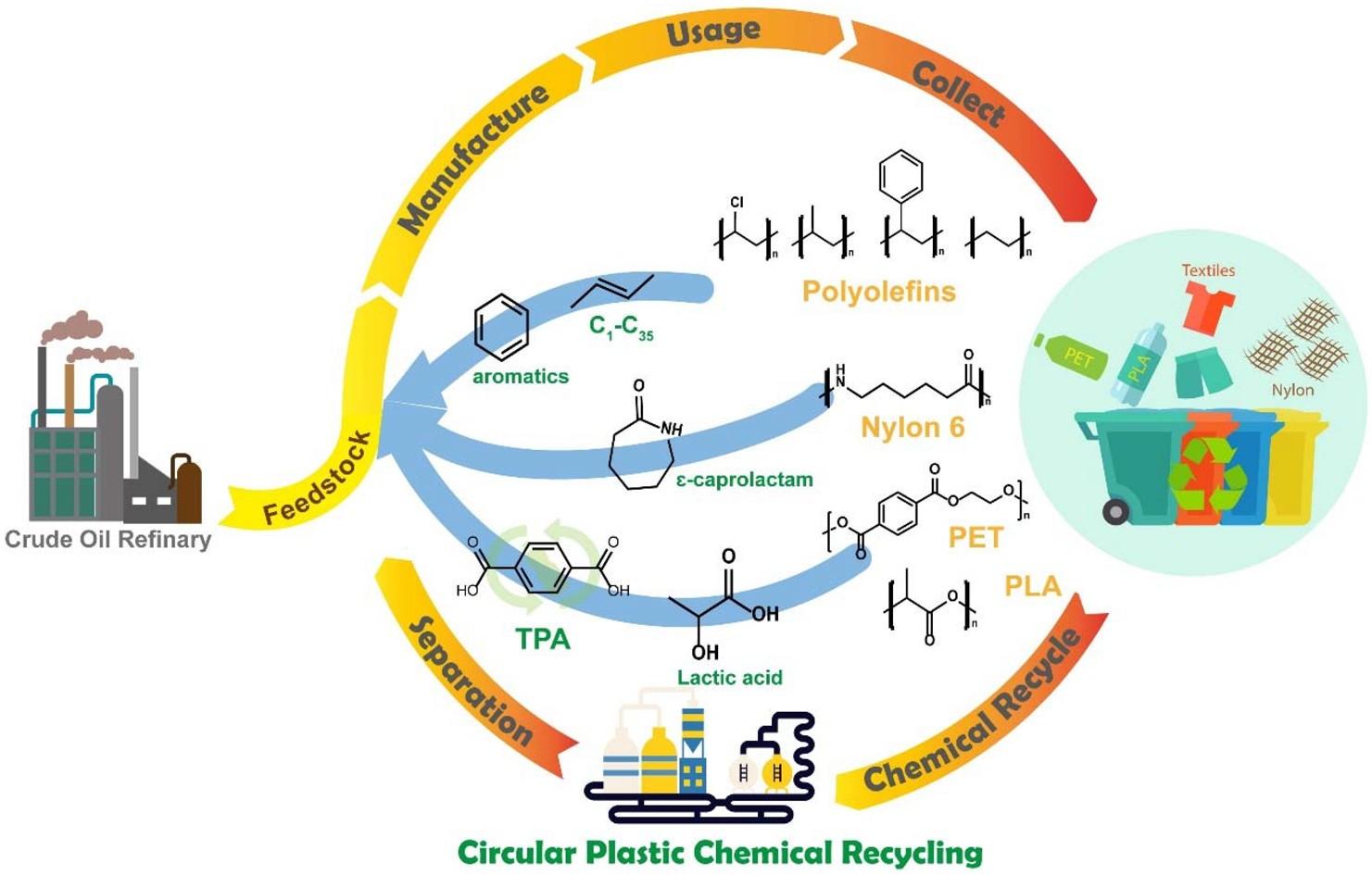
Every polymer product begins with resources, energy and chemical processing. Raw materials are converted into chemical building blocks, polymers and finally finished products. When those products are discarded, a significant amount of that original material structure can still remain.
The challenge is to determine whether that remaining value can be recovered safely, technically and economically. Recycling provides a pathway to move selected waste streams back into the manufacturing system rather than allowing useful carbon and chemical structures to be permanently lost.
Why recycling matters
The burden of polymer waste cannot be solved by disposal alone.
PET and PU products are designed to deliver performance, durability and long service life. Those same properties can make their end-of-life management challenging. Where suitable recycling pathways exist, recovering material or chemical value can reduce the quantity of useful polymer resources that are simply lost from the production cycle.
Reduce Waste Burden
Recycling can divert suitable polymer waste away from disposal routes and return part of the material into productive use.
Recover Material Value
Waste polymers still contain valuable carbon and chemical structures that may be recovered through appropriate recycling technologies.
Reduce Virgin Demand
Recovered chemistry can, where technically suitable, replace a portion of new virgin chemical feedstock required for subsequent manufacturing.
Keep Carbon in Circulation
Instead of repeatedly relying only on new fossil-derived feedstocks, circular systems seek to keep useful carbon resources circulating through successive material cycles.
From linear to circular
A circular economy behaves more like a cycle than a one-way chain.
In a conventional linear system, resources are extracted, converted into chemicals, transformed into polymers, made into products and eventually discarded. The flow largely moves in one direction.
Recycling introduces another possibility: after a product reaches the end of its useful life, suitable material can be collected, processed and returned to the manufacturing chain.
This does not mean that every waste stream can be recycled indefinitely or that recycling has no environmental or economic cost. It means that, where the technology and economics are appropriate, waste can become another source of industrial feedstock.
The circular material principle
Resources
Carbon & raw materials
Chemicals
Building blocks
Polymers
PET, PU & others
Products
Useful materials
Recycling & Chemical Recovery
Suitable waste can re-enter the material system as recovered feedstock or regenerated chemistry.
The central idea
The goal is not simply to collect waste.
The goal is to recover its useful value.
That distinction is important. Effective recycling requires the right feedstock, the right technology, appropriate economics and a real market for the recovered material. The following sections examine how that system works for PET and PU.
The conventional system
Modern materials begin with a long chain of resources and chemistry.
Many of the polymers used in everyday products ultimately begin with carbon-rich raw materials. Fossil resources such as crude oil and natural gas are processed into hydrocarbon feedstocks, which are then converted into chemical intermediates and monomers.
These building blocks are transformed into polymers such as PET, polyurethane and many other materials. The polymers are then converted into products that serve society for periods ranging from days to decades.
The problem appears at the other end of the chain: when the product reaches the end of its useful life, the material can become waste even though much of its chemical structure remains.
Following the chemistry
From carbon resource to finished polymer
A polymer product is the result of multiple transformation stages. Understanding this chain helps explain why recovering polymer waste can have value beyond simply reducing the volume of waste.
Stage 01
Resource
Carbon-rich natural resources provide the starting point for many chemical value chains.
Stage 02
Chemistry
Refining and chemical processing create intermediates used to manufacture polymer building blocks.
Stage 03
Polymer
Monomers and reactive intermediates are converted into long-chain polymer materials.
Stage 04
Product
Polymers become bottles, packaging, foams, coatings, adhesives, insulation and countless other products.
Stage 05
End of Life
The material enters collection, recycling, recovery or disposal pathways after its useful life.
The pressure point
A one-way system continuously needs new inputs.
In a predominantly linear system, production depends on a continuous supply of new raw materials. New feedstock enters the system, new chemicals are produced, new polymers are manufactured and new products are placed into service.
At the same time, previously manufactured materials are continuously reaching their end of life. If those materials are not effectively recovered, the system effectively operates with two simultaneous flows: new resources entering and used materials leaving.
Continuous input
New resources → new chemicals → new polymers
Continuous output
Products → used materials → waste streams
Changing the direction
Recycling adds another pathway to the chemical economy.
Instead of viewing end-of-life material only as an output, a circular system asks whether part of that material can become an input again.
Traditional flow
Linear Chemical Economy
The main material flow moves forward, while the connection between end-of-life waste and new chemical production remains limited.
Circular opportunity
Circular Chemical Economy
The objective is to create practical loops where suitable waste streams can return to manufacturing as useful feedstocks, reducing the need to rely exclusively on new virgin inputs.
PET & PU
The same circular principle can apply to very different polymers.
PET and PU are chemically different materials and therefore require different recycling approaches. The important common principle is that their end-of-life streams should be evaluated for the highest practical recovery route rather than assuming that all polymer waste has the same solution.
PET
Polyester-based polymer
PET can enter different recovery pathways depending on purity, contamination, product form and the desired recovered output. Chemical recycling can be used where the objective is to recover useful chemical value from suitable PET streams.
PU
Polyurethane materials
PU represents a broader family of materials with different chemistries, formulations and crosslinking structures. Its recycling route therefore depends strongly on the specific polyurethane waste stream and the quality of the recovered material required.
Recycling is therefore not one technology.
It is a decision about the best practical recovery pathway for a particular waste stream.
The recycling journey
Recycling begins long before the reactor or processing equipment.
Chemical recycling is only one stage of a much larger system. Before a waste polymer can become a useful feedstock, it must be collected, identified, separated, transported and prepared for processing.
The quality of these upstream steps directly affects the quality, consistency and economics of the recovered material. A clean, well-characterised waste stream is fundamentally different from a mixed and heavily contaminated waste stream.
Recycling is therefore a complete supply chain—not simply a processing machine.
Step by step
What happens to polymer waste?
The exact process depends on the polymer, contamination level, product form and desired recovered output. However, most recycling systems follow a sequence of practical preparation and recovery steps.
Collection
Post-consumer and post-industrial polymer waste is collected from suitable sources and moved into the recovery network.
Sorting
Materials may need to be separated by polymer type, colour, formulation, contamination level or other relevant properties.
Preparation
Washing, drying, size reduction and other preparation steps can make the feedstock suitable for the selected recycling process.
Recovery
The prepared material enters an appropriate mechanical, chemical or other recovery pathway.
Separation
Depending on the technology, unwanted fractions and process residues may need to be separated from the recovered stream.
Refinement
Further treatment may be required to achieve the chemical, physical or purity characteristics needed for the next application.
Quality Control
Recovered material must be characterised so that it can be matched with a realistic downstream application.
New Application
The recovered material becomes an input for another product or chemical manufacturing process.
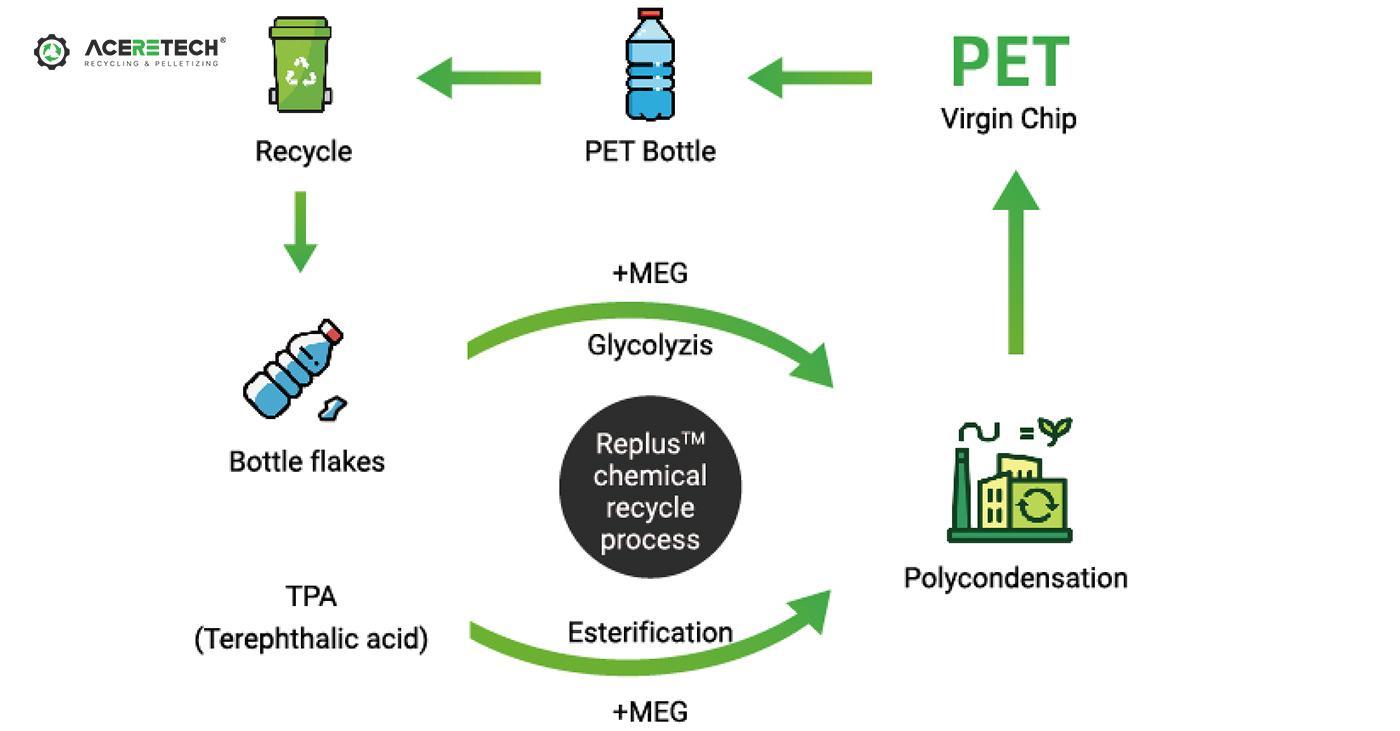
PET lifecycle
The objective is to create another route after the useful life of the product.
PET is a useful example of how a polymer can move through several stages during its life. Raw materials become chemical intermediates, the intermediates become polymer, and the polymer becomes products such as bottles, packaging, fibres and other polyester materials.
At the end of use, the material can follow different pathways. Some PET can be reused or mechanically recycled. Other streams may be suitable for chemical recycling, where the objective is to recover chemical value rather than simply preserve the original physical form.
The right route depends on the material, contamination, economics and required output.
Choosing the recovery route
Not every polymer waste stream needs the same recycling technology.
Recycling should be selected according to the characteristics of the waste and the value of the recovered output. Mechanical and chemical recycling solve different problems and can complement one another.
Route 01
Mechanical Recycling
Mechanical recycling generally seeks to recover the polymer material in a form that can be processed again without fundamentally breaking the polymer into smaller chemical building blocks.
Can be effective for relatively clean and suitable homogeneous waste streams.
Can preserve the polymer as a material rather than converting it into chemical intermediates.
Repeated processing and contamination can affect material properties and the range of suitable applications.
Route 02
Chemical Recycling
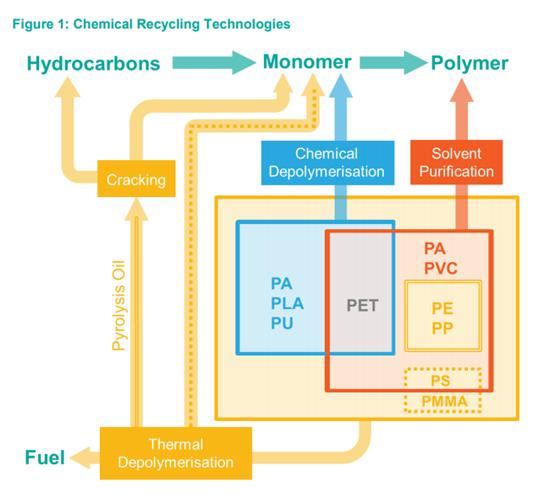
Chemical recycling uses chemical or thermochemical processes to transform suitable polymer waste into useful chemical intermediates, feedstocks or other recoverable products.
Can access chemical value that is difficult to recover through simple mechanical processing.
May create feedstocks for new chemical or polymer applications.
Requires appropriate chemistry, process control, energy, separation and economics.
PET ≠ PU
The word “polymer” describes a broad family of materials.
Recycling technologies cannot be selected simply because a material is labelled plastic or polymer. The molecular structure, additives, fillers, crosslinking, contamination and product history all influence the appropriate recovery route.
| Factor | PET | PU | Recycling implication |
|---|---|---|---|
| Polymer chemistry | Polyester | Polyurethane | Different chemical recovery routes may be required. |
| Typical waste forms | Bottles, fibres, films, sheets and other polyester products | Foams, elastomers, coatings, adhesives and other PU systems | Collection and preparation requirements vary significantly. |
| Contamination | Labels, caps, dyes, additives and other materials | Additives, fillers, pigments and formulation-specific components | Feedstock preparation is important for consistent recovery. |
| Recovery objective | Polymer or chemical value | Recovered polyol-containing or other useful chemical fractions, depending on the PU chemistry | The recovered output should be defined before selecting the recycling route. |
The important transition
The recycling process changes waste
into a controlled industrial feedstock.
Once waste has been collected, sorted and prepared, the next question is no longer simply “How do we dispose of it?” The more useful question becomes: “What chemical or material value can we recover from it, and where can that recovered value be used?”
Chemical recovery
Sometimes the value of a polymer is hidden in its chemistry.
Mechanical recycling attempts to preserve the polymer as a material. Chemical recycling takes a different approach: it seeks to transform suitable polymer waste into chemical intermediates, feedstocks or other useful products.
This can be particularly relevant when the original material form is no longer suitable for direct reuse, or when recovering chemical functionality creates a more useful downstream product.
The purpose is not to make waste disappear. The purpose is to convert part of its remaining material value into a controlled input for another manufacturing process.
The transformation
Before
Polymer Waste
Used, contaminated or otherwise unsuitable polymer material requiring an appropriate recovery pathway.
Processing
Chemical Conversion
A controlled process transforms the selected waste into recoverable chemical fractions.
After
Recovered Chemistry
A material stream characterised for a defined downstream application.
What are we trying to recover?
The output should have a defined purpose.
A successful recycling process is not measured only by how much waste enters the plant. It must also consider what comes out, the quality of that output, and whether it can replace or supplement a useful industrial feedstock.
Chemical Intermediates
Recovered chemical fractions can become inputs for further synthesis or formulation.
Regenerated Polyols
Suitable recovered polyester chemistry can be converted into polyol products for selected polyurethane applications.
Recovered Feedstock
Depending on the recycling route, recovered material can become feedstock for another manufacturing process.
Process Fractions
Not every input becomes the desired product. Residues, wastewater and other process fractions must also be managed.
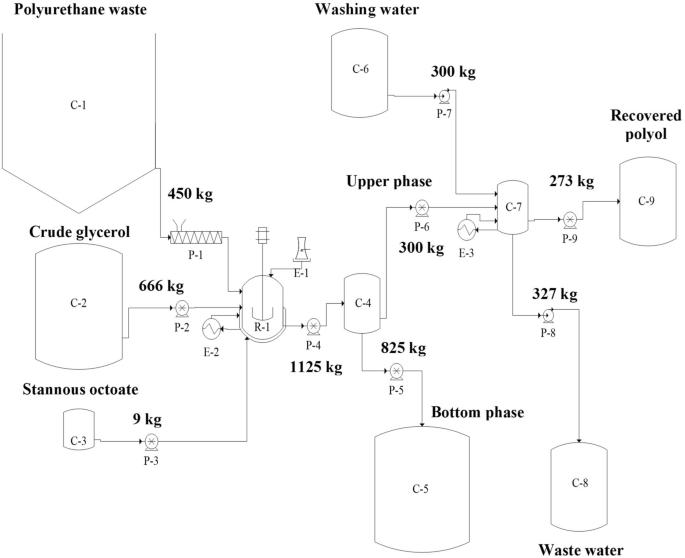
Mass balance
What enters a recycling process does not all become the final product.
Material balance is one of the most important concepts in industrial recycling. A recycling plant receives a defined input and produces several output streams.
Some of the input may become the intended recovered product. Other portions can leave as moisture, contaminants, residues, wastewater, losses or other process fractions.
Therefore:
A higher recovery yield generally means more of the incoming material is converted into useful output—but yield alone does not determine whether a recycling process is technically or economically successful.
Inside the process
A simplified recycling mass balance
The actual balance varies by polymer, process and feedstock. The following model illustrates the basic industrial principle.
Input
100 kg Waste Feedstock
• Polymer material
• Moisture
• Contaminants
• Additives / other fractions
Controlled process
Preparation
Conversion
Separation & QC
Output streams
Recovered Product
Useful chemical or material output
Process Residues
Non-recoverable or separated fractions
Wastewater / Other Streams
Require appropriate treatment or management
Recovery yield
More recovery is useful—but useful recovery is the real objective.
It is tempting to judge recycling only by the percentage of waste recovered. Industrial decision-making is more complex. The recovered material must also meet the requirements of its intended application and be produced at a commercially sensible cost.
A process with high nominal recovery but poor product quality, excessive energy consumption or expensive purification may not deliver the best overall outcome.
Simple concept
Material Recovery Yield
Useful recovered output
Relevant material input
The definition of “useful output” should be linked to the intended application and quality specification.
A realistic circular economy
Good recycling does not mean pretending that nothing is lost.
Real recycling systems have energy requirements, process losses, residues and costs. The objective is to maximise the useful value recovered from an appropriate waste stream while managing the remaining fractions responsibly.
Recover
Capture as much useful material or chemical value as reasonably possible.
Refine
Bring the recovered output to the quality required for a real downstream application.
Manage
Treat and manage residues, wastewater and other non-recovered fractions appropriately.
Recycling Is a Supply Chain, Not a Single Process
A successful recycling system depends on much more than the recycling plant itself. Waste must be generated, collected, identified, segregated, transported, prepared, processed and converted into a material that another manufacturer can actually use.
Waste Generator
PET / PU waste is created
Collection
Waste is gathered
Sorting
Material is identified
Transport
Waste reaches processor
Preparation
Cleaning & size reduction
Recovery
Mechanical / chemical processing
Quality Control
Recovered material is tested
New Product
Recovered chemistry enters production
Feedstock Quality
Consistent polymer type, contamination level, moisture and composition make downstream recycling easier to control.
Logistics Efficiency
Collection radius, transportation distance, load density and aggregation can strongly influence the delivered cost of waste.
End-Market Demand
Recycling becomes more valuable when recovered material has a defined application and consistent technical specification.
Not All Polymer Waste Behaves the Same
The source of the waste can have a major influence on collection, sorting, contamination, preparation requirements and recycling economics.
Post-Industrial Waste
Material generated during manufacturing, conversion, trimming, rejected batches, off-cuts or process operations.
Often more consistent in polymer composition
Potentially easier to segregate
Lower contamination can be possible
Traceability may be better
Can be attractive for controlled chemical recovery
Post-Consumer Waste
Material discarded after use by consumers, businesses or institutions and subsequently entering the waste stream.
Greater variability in composition
Potentially higher contamination
More sorting may be required
Collection networks become important
Preparation cost can become a major factor
The Recycling Plant Is Only One Part of the System
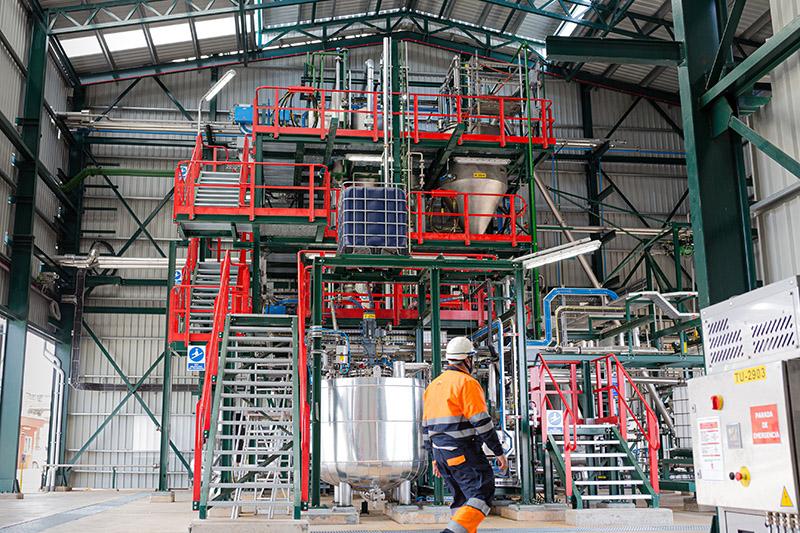
Behind every kilogram of recovered material is an operating system involving equipment, utilities, people, testing, maintenance, logistics and environmental controls.
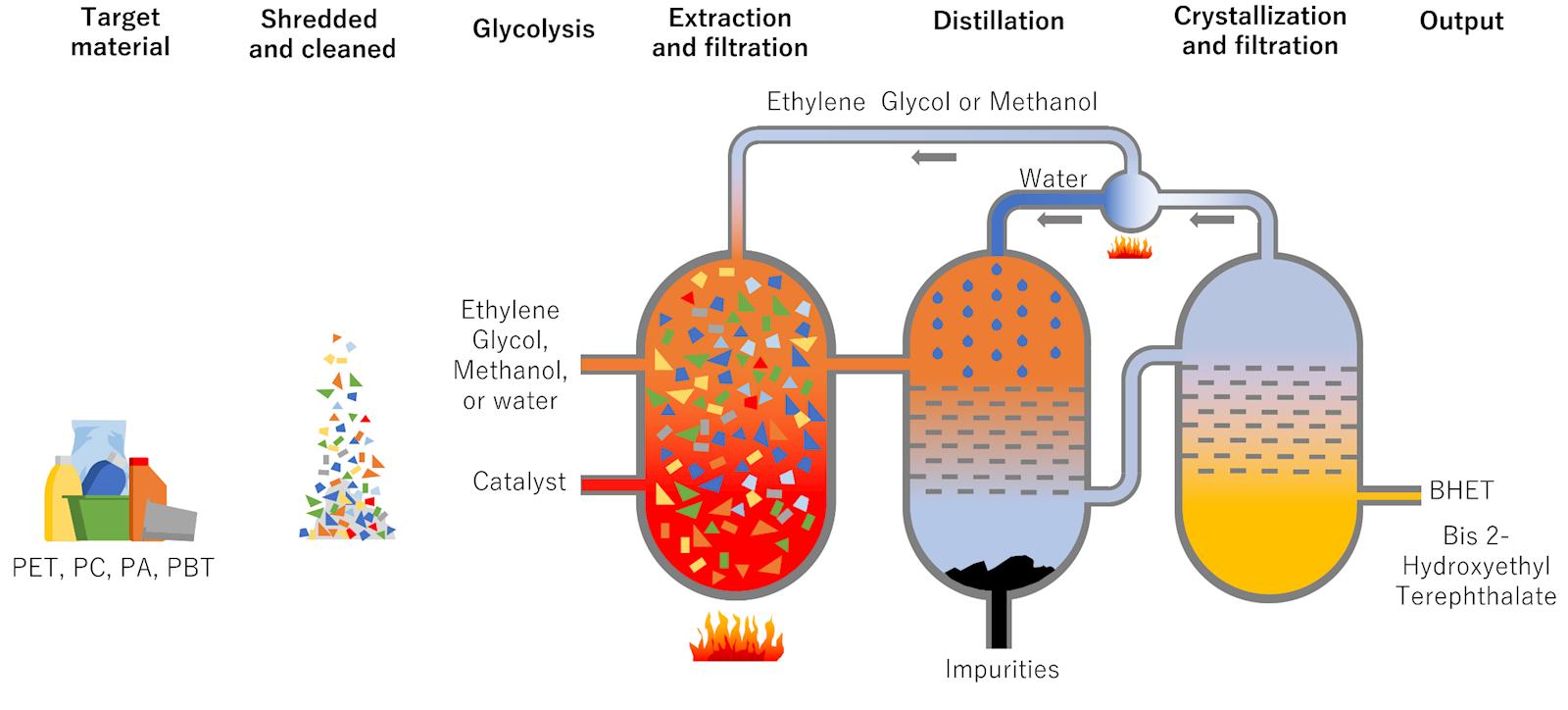
For chemical recycling, this can additionally include reaction systems, separation, filtration, purification, moisture control, quality testing and management of process residues.
What Does Recycling Actually Cost?
The economics of recycling are determined by the complete chain, not simply by the cost of processing waste. The delivered cost of a recovered material reflects everything required to transform an inconsistent waste stream into a controlled industrial feedstock.
Feedstock
Cost or value associated with obtaining suitable waste material.
Collection
Labour, aggregation and handling required to gather the material.
Sorting
Identification and separation of usable polymer streams.
Transportation
Movement from waste source to aggregation or processing site.
Preparation
Washing, drying, shredding, grinding or other preparation.
Utilities
Electricity, heating, cooling, water and other process utilities.
Process Chemicals
Glycols, catalysts, additives, filtration media and other inputs where required.
Labour
Operators, technicians, quality control and plant management.
Equipment
Depreciation, maintenance and replacement of processing equipment.
Quality Control
Testing of incoming feedstock, intermediates and final recovered material.
Environmental Control
Wastewater, residues, emissions management and compliant disposal or treatment.
Outbound Logistics
Packaging, storage and transportation of recovered material to customers.
From Waste Cost to Recovered-Material Cost
A useful way to understand recycling economics is to follow the material through each cost layer.
Scale and Consistency Can Change the Economics
Recycling economics can improve as collection networks, equipment utilization, process control and customer demand become more predictable. However, larger scale does not automatically mean better recycling; feedstock quality and process efficiency remain critical.
Small Scale
Opportunity
Flexible operations
Consideration
Higher unit overhead can occur
Growing Scale
Opportunity
Better equipment utilization
Consideration
More consistent production
Industrial Scale
Opportunity
Integrated supply chain
Consideration
Improved process economics
Circular Network
Opportunity
Stable supply + stable demand
Consideration
Greater material recovery potential
The Best Recycling Strategy Is a Balanced One
Different waste streams require different recovery pathways. The objective should be to select the highest practical value pathway while considering material quality, contamination, economics, energy requirements and environmental controls.
Reuse
Keep the existing product or component in service where practical.
Mechanical Recycling
Recover material without fundamentally changing the polymer chemistry.
Chemical Recovery
Convert suitable polymer waste into useful chemical intermediates or regenerated materials.
Energy Recovery
Recover energy where material recovery is technically or economically unsuitable.
Controlled Disposal
Manage unavoidable residues responsibly when recovery is not practical.
Balanced recycling means matching the waste stream to the right recovery technology. Chemical recycling is not a universal replacement for mechanical recycling, just as mechanical recycling is not suitable for every contaminated or chemically complex waste stream.
Closing the Loop Requires Both Supply and Demand
Recycling becomes a circular economy only when recovered material can move back into productive use. Waste suppliers, recyclers, chemical manufacturers, formulators and end-product manufacturers therefore become connected parts of the same value chain.
Waste → Feedstock
Generators, collectors, aggregators and sorting systems create a reliable stream of suitable material for recycling.
Feedstock → Chemistry
Recycling technologies convert selected waste streams into controlled recovered materials, intermediates or regenerated chemistry.
Chemistry → Product
Manufacturers and formulators incorporate recovered chemistry into new material systems, creating demand for recycled inputs.
Waste becomes valuable when the entire chain is designed to recover, qualify and use it.
Recycling Is Also an Energy Question
Every material pathway requires energy. The environmental value of recycling therefore depends not only on whether waste is recovered, but also on what energy, processing steps and raw materials are required to produce the recovered material.
Virgin Chemical Production
Fossil resource extraction
Oil and natural gas can serve as starting resources for many chemical value chains.
Chemical processing
Hydrocarbons are converted into chemical building blocks.
Polymer production
Building blocks are transformed into polymeric materials.
Product manufacturing
Polymers become packaging, foams, coatings and other products.
Chemical Recovery from Waste
Recover polymer waste
Existing material is collected instead of immediately becoming a disposal burden.
Prepare the feedstock
The waste is sorted, cleaned and conditioned for the selected process.
Recover chemical value
Suitable polymers can be converted into useful chemical intermediates or regenerated materials.
Return chemistry to manufacturing
Recovered material can become an input for another industrial product.
Recovering Chemistry Can Reduce Dependence on Virgin Inputs
Producing new chemical building blocks generally requires raw materials, processing energy and industrial infrastructure. Recovering useful chemistry from existing polymer waste creates another possible source of material for manufacturing.
The objective is not to claim that every recycling process is automatically lower-carbon. Instead, the relevant question is whether a well-designed recovery route can reduce the need for virgin inputs while managing its own energy, process and environmental requirements responsibly.
The environmental benefit of recycling should be measured across the complete system — feedstock, energy, processing, recovery yield, residues and the material displaced.
Why Chemical Recovery Matters for PET and PU
PET and polyurethane are chemically different materials, but both demonstrate an important principle: a discarded polymer can still contain valuable chemical structure that may be recovered through appropriate processing.
Polyester Chemistry
Through controlled chemical processing, PET can be transformed into regenerated polyester-based intermediates and polyols suitable for selected polyurethane and coating applications.
Polyurethane Chemistry
Selected polyurethane waste streams can also be processed to recover useful chemical fractions. The practical recovery route depends strongly on the PU chemistry, formulation and contamination profile.
From Waste Management to Chemical Value Recovery
Enviol focuses on the point where recycling meets industrial chemistry: converting suitable polymer waste into controlled recovered materials that can re-enter manufacturing.
Identify
Understand the polymer waste stream and its composition.
Prepare
Condition and prepare the feedstock for processing.
Regenerate
Use controlled chemistry to recover useful material value.
Qualify
Characterize the recovered material against application requirements.
Reuse
Return the recovered chemistry to industrial applications.
Recover What Has Value
Polymer waste can contain valuable carbon-based chemistry. Recovery seeks to keep that value in productive use rather than treating the material only as a disposal problem.
Build on Existing Chemistry
Instead of always starting with virgin chemical resources, chemical recycling creates an opportunity to recover useful intermediates from materials that already exist.
Make Recovered Materials Useful
Recycling has greater value when the recovered material meets defined technical requirements and can reliably enter an industrial formulation or manufacturing process.
Building a Circular Chemical Economy
The long-term objective of polymer recycling is not simply to move waste from one location to another. It is to create a system where materials remain useful for longer and chemical value can repeatedly return to productive applications.
Raw Materials
Fossil and renewable chemical resources
Polymers
PET, PU and other engineered materials
Products
Packaging, foams, coatings and components
Recovered Chemistry
Chemical value returned to the material cycle
Polymer waste should be viewed not only as a waste problem, but also as a potential source of recoverable industrial chemistry.
Responsible Recycling Means Measuring the Whole System
Recycling should be designed around technical performance, economic viability and environmental responsibility at the same time.
Material
How much useful material is actually recovered?
Energy
How much energy is required to process the waste?
Environment
How are residues, wastewater and emissions managed?
Economics
Can the recovered material compete as a useful industrial input?
The strongest circular systems are those where environmental ambition and industrial practicality work together.
Turning Polymer Waste Back Into Industrial Value
Enviol is working toward a more circular chemical economy by developing and supplying regenerated polyester polyols and supporting chemical recovery pathways for polymer waste.
Recover the material.
Recover the chemistry.
Keep the value in circulation.
PET & PU Recycling • Chemical Recovery • Circular Chemistry